
Upgrading Builder-Grade Fixtures
Westover Hills homes built between 2015 and 2021 experience widespread builder grade plumbing fixture failures. Searing July heat and mineral heavy aquifer water degrade cheap plastic internal valves, leading to low pressure and leaks. Upgrading to solid brass and ceramic disc fixtures protects properties from high pressure surges and damage.
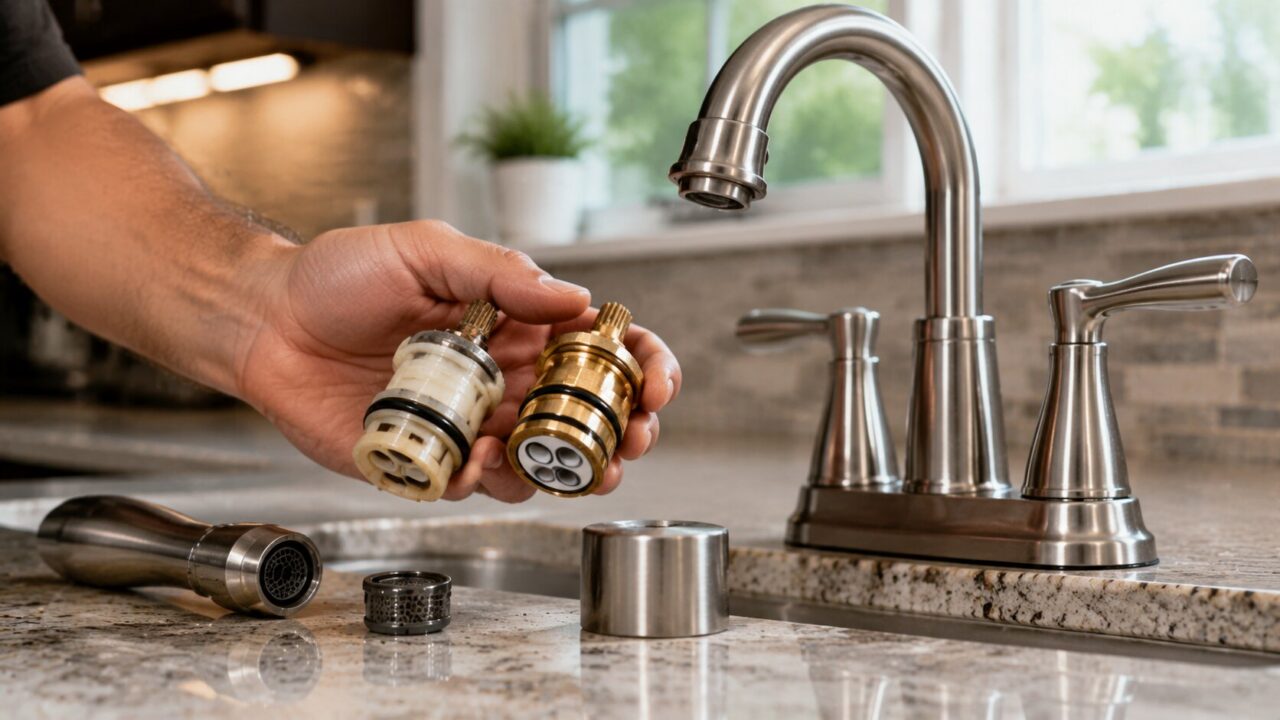
Upgrading from plastic internal faucet parts to solid brass bodies and ceramic disc cartridges helps Westover Hills homeowners improve fixture durability against hard water and pressure fluctuations.
The High Pressure Surge Meets Builder Grade Plastics
If you commute daily along the Highway 151 corridor, passing the sprawling campus of Northwest Vista College, or navigate the busy merge points onto Loop 1604 West, you understand the rapid development of Far West San Antonio. Returning home to master-planned subdivisions like Westover Crossing or Reserve Meadows, you expect your household systems to perform flawlessly. However, homes built here between 2015 and 2021 are now reaching a critical plumbing transition point.
During these construction boom years, production builders routinely installed cheap fixtures. These faucets, showerheads, and toilet fill valves rely heavily on cheap plastic internal components rather than solid metal.
The primary threat to these fragile systems is the extreme water pressure delivered by the San Antonio Water System (SAWS). Static water pressure in northwest Bexar County ranges from 35 to 175 psi. While residential fixtures are only rated for a maximum of 80 psi, builders install cheap Pressure Reducing Valves (PRVs) that typically fail or lose calibration around the eight-to-ten-year mark.
When your PRV fails, high-pressure municipal surges and water hammer from modern appliances slam directly into your home’s pipes. Under this persistent mechanical stress, weakened plastic internals are primed to split, crack, or blow out completely.
The Chemistry of July Heat and Hard Water Scale
The deterioration of builder-grade fixtures accelerates dramatically during the brutal July heat wave. Searing South Texas sun bakes the ground, raising soil temperatures and heating the water sitting in shallow municipal mains.
The groundwater supplied to Westover Hills is drawn from the Edwards Aquifer, which is highly mineral-rich, averaging 200 to 300+ ppm of hardness. When this hard water experiences the rising temperatures of July, it triggers a thermodynamic process known as retrograde solubility. Unlike most minerals, calcium carbonate becomes less soluble as water temperatures rise, causing it to rapidly precipitate as solid limescale inside your fixtures.
Furthermore, SAWS disinfects this aquifer water with chlorine gas. This chemical residual, combined with hot summer water temperatures, actively attacks the polymer chains of the plastic internal parts—such as acetal (polyoxymethylene) cartridge shells and EPDM rubber seals. This process, known as thermal-oxidative degradation, makes the plastic brittle and causes rubber seals to harden and shrink.
Homeowners usually notice very specific warning signs of this internal decay:
- The Sputtering Drizzle: Your kitchen or bathroom faucet spray becomes weak, spits, or shoots water in erratic directions due to limescale clogging the aerator screen.
- The Gritty Handle Friction: When you turn your shower or sink handle, you feel a rough, grinding resistance as calcium scale scratches the plastic housing.
- The Under-Cabinet Seepage: High back-pressure from a clogged aerator forces water backward past degraded O-rings, allowing water to drip silently into your vanity. This creates a damp, sour, musty odor that rots your cabinet bases.
Advanced Testing with Digital Manometers and Acoustic Probes
Replacing only a single cartridge or applying silicone does not address system-wide high-pressure damage. At Five Star Plumbing, we prioritize scientific testing over temporary patches. We do not guess; we use advanced tools to verify your entire system’s health.
First, we connect a digital manometer to your plumbing system to run a dynamic water pressure audit. If our manometer registers static pressure exceeding 80 psi, we have definitive proof that your PRV has failed. No new cartridge will survive under those conditions.
Second, we deploy the LeakTronics Pro Complete Kit. Shifting clay soils in northwest San Antonio place structural stress on under-slab pipes. Our high-sensitivity acoustic transducers listen through your flooring, verifying that a hidden sub-slab line break is not the true cause of your pressure issues.
Our point of absolute certainty occurs when our manometer and acoustic sensors isolate the exact mechanical failure, allowing us to perform a surgical, permanent repair.
Upgrading to Professional Brass and Ceramic Disc Cartridges
Upgrading your home’s fixtures requires transitioning from fragile builder-grade plastics to professional-grade, corrosion-resistant metals.
- The Cheap Way: Buying the cheapest retail-grade replacement faucet or toilet fill valve from a big-box store. These fixtures still contain plastic-bodied cartridges and thin rubber washers. Under San Antonio’s hard water and high-pressure surges, these cheap parts fail again within 3 to 5 years.
- The Five Star Way: We install professional-grade fixtures constructed with solid brass bodies and ceramic disc cartridges. Ceramic disc valves feature two ultra-flat, polished alumina ceramic discs that slide against each other with sub-micron precision. Because alumina ceramic is second only to diamond on the Mohs hardness scale, it easily grinds away microscopic mineral scale without scratching. These discs self-clean with every turn, ensuring leak-free performance that easily endures for 10 to 20 years.
| Cartridge Type | Material Composition | Heat and Scale Resistance | Typical Lifespan |
| Builder Grade | Acetal plastic and rubber | Low (Prone to heat deformation) | 3 to 5 years |
| Professional Grade | Solid brass and alumina ceramic | High (Self-cleans mineral scale) | 10 to 20 years |
Preventive Water Management for Westover Hills Homes
To extend the lifespan of your upgraded plumbing fixtures and prevent costly water damage:
- **Replace Your PRV:**Have a licensed plumber replace your Pressure Reducing Valve every 5 to 10 years to hold your home’s water pressure at a safe level between 50 and 65 psi.
- Install aWater Softener**:**Edwards Aquifer water is extremely hard. Installing a demand-initiated water softener removes the calcium and magnesium before they can deposit scale inside your cartridges and appliances.
- Flush Your Water Heater: Flush your tank water heater 2 to 3 times a year to remove loose calcium carbonate sediment that travels through your hot water lines and clogs faucet aerators.
- Dry the Base: Wipe the base of your kitchen and bathroom faucets dry after use to prevent standing water from evaporating and forming limescale around the seals.
Protect Your Westover Hills Property Today
Are you experiencing sputtering water flow, rattling pipes, or sudden drops in shower pressure? Don’t let cheap builder-grade plastics and hard water destroy your home’s cabinetry and foundations. At Five Star Plumbing, we provide the licensed expertise, specialized tools, and premium brass materials needed to permanently secure your home. Julian Campos and our certified team specialize in water pressure calibration, professional faucet descaling, and high-durability fixture upgrades. Reach out to Five Star Plumbing at (210) 673-0797 and at 2780 FM471, Castroville, TX 78009 today to schedule your comprehensive home plumbing inspection and stop the leaks before they start!
Frequently Asked Questions
Why do new home fixtures fail after only five years?
Yes, this is due to the chemical degradation of cheap plastic internal components exposed to San Antonio’s mineral-heavy water and high summer temperatures. High-hardness water quickly wears down unreinforced plastic cartridges, causing them to leak and stick.
Can high water pressure crack plastic faucet parts?
Yes, municipal water pressure surges can reach up to 175 psi, which easily puts excessive mechanical strain on fragile plastic internal bodies and gaskets, causing them to split or rupture.
Will a water softener extend faucet lifespan?
Yes, by replacing hard calcium and magnesium ions with non-scaling sodium ions, a water softener completely prevents the abrasive limescale buildup that scratches and destroys faucet cartridges and rubber O-rings.
Do I need a permit to replace builder-grade fixtures in San Antonio?
No, simple replacements of kitchen and bathroom faucets, toilets, and sinks are generally exempt from permit requirements under local building codes, provided you do not alter the main supply or drain-line configurations.