
Faucet Mineral Buildup in San Antonio
Rising July temperatures in San Antonio accelerate mineral precipitation inside faucet aerators and showerheads due to retrograde solubility. Hard aquifer water releases calcium carbonate faster in warmer conditions, clogging narrow fixtures. Professional descaling and water softeners protect plumbing systems from severe back-pressure leaks during peak summer heat waves in Texas.
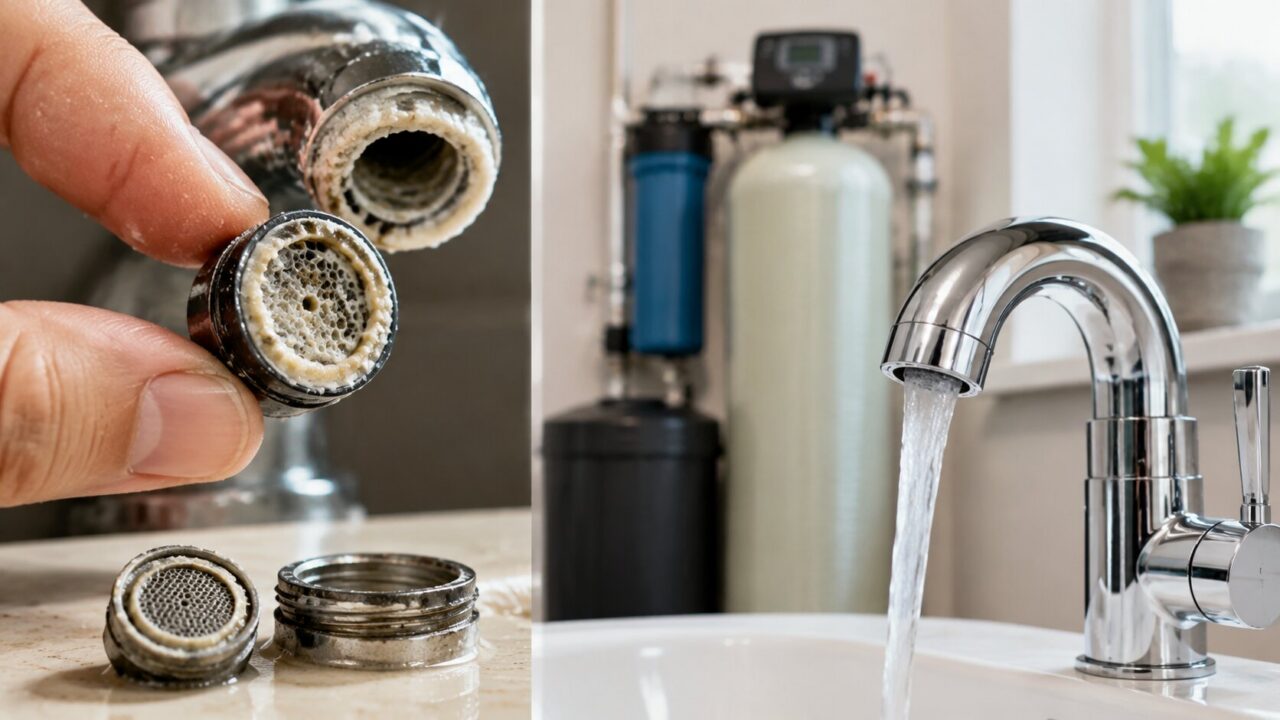
Hard water minerals can accumulate inside faucet aerators and showerheads, reducing water flow and contributing to fixture problems during hot Texas summers.
The Science of retrograde Solubility in the July Heat
When the brutal July heat wave settles over northwest Bexar County, San Antonio homeowners watch their utility bills climb as air conditioners fight the outdoor climate. But while the heat is highly visible outside, a silent chemical reaction is accelerating inside your plumbing system. This phenomenon is driven by a thermodynamic anomaly known as retrograde solubility.
Most common solids become more soluble as water temperatures rise. However, calcium carbonate behaves in the exact opposite manner. As water temperatures increase, calcium carbonate becomes significantly less soluble and rapidly precipitates out of the liquid state.
The groundwater supplied to northwest San Antonio and Castroville is drawn primarily from the Edwards Aquifer. This water is extremely mineral-heavy, carrying up to 20 grains per gallon of dissolved calcium and magnesium. When this highly mineralized water is subjected to the soaring temperatures of a South Texas July, the retrograde solubility effect triggers a rapid crystallization process, forming hard, white limescale inside your home’s delivery points.
How Summer Water Main Warming Triggers Scale Build Up
During the peak of summer, shallow municipal water lines and exposed residential supply pipes bake under the intense South Texas sun. Ground temperatures at water main depths can rise significantly, pre-heating the incoming cold water supply before it ever enters your home.
When this already-warm water enters your water heater—where it is heated further to a bactericidal 140°F—the calcium carbonate instantly drops out of solution. The mineral crystals are carried through your hot water lines and deposit directly onto the narrowest passages in your plumbing system.
The primary target is the faucet aerator or the fine rubber nozzles of your showerhead. As the water passes through these tiny openings, the scale builds up, narrowing the pathway.
This restriction causes a dramatic drop in flow rate. Because water is incompressible, this restriction generates severe back-pressure inside the fixture body. Over time, this constant hydraulic force pushes water backward past your faucet’s internal O-rings and cartridge seals, resulting in silent, steady leaks that pool inside your kitchen and bathroom cabinets.
Sensory Symptoms of Severely Clogged Faucets
Many homeowners do not realize their fixtures are failing until they are faced with an expensive repair bill. However, a scaling faucet provides clear sensory warning signs before a catastrophic leak occurs:
- The Spitting Spray: Instead of a smooth, aerated stream, the water spits and sprays erratically in different directions, splashing onto your countertops or clothing.
- The High-Pitch Whistle: When you turn on your shower or kitchen tap, you hear a high-pitched whistling or buzzing sound behind the wall, indicating that water is struggling to force its way through a choked aerator mesh.
- The Gritty Handle Glide: When rotating a single-handle faucet, you feel a distinct, rough resistance or hear a scraping sound as hard calcium crystals scratch the internal ceramic discs.
- The Musty Cabinet Smell: Opening the cabinet door under your sink reveals a damp, sour, musty odor, indicating that back-pressure has forced water past the stem seals, where it is slowly rotting your wooden cabinetry.
Professional Inspection Precision with Digital Manometers
A generic handyman service will often suggest simply wiping down the faucet tip or swapping out a cartridge without addressing the systemic water conditions of your home. At Five Star Plumbing, we utilize a master-level inspection process to pinpoint the exact failure point and protect your investment.
When we inspect a home in Alamo Ranch or Helotes, we connect a digital manometer to your system to run a dynamic pressure audit. High elevation pumping stations in northwest Bexar County can cause water pressure to fluctuate erratically, sometimes peaking at a massive 175 psi.
If your home’s Pressure Reducing Valve (PRV) has failed—a common issue around the eight-to-ten-year mark—your fixtures are being subjected to excessive pressure. Running high-pressure water through a scale-choked aerator is a primary cause of burst supply lines under the sink.
We also deploy the LeakTronics Pro Complete Kit to run non-invasive acoustic testing. Our high-sensitivity acoustic sensors can trace the distinct hiss of a sub-slab copper joint failure before recommending any fixture descaling or water softener upgrades, ensuring your entire system is structurally sound.
Comparing Descaling Methods and Long Term Protection
When addressing severe scale buildup, San Antonio homeowners must understand the physical limits of different materials and finishes.
- The Cheap Way: Soaking the entire faucet body in harsh chemical cleaners or scraping the aerator tip with a wire brush. This completely ruins delicate decorator finishes like matte black or brushed nickel and strips the protective sealants. Chrome-plated zinc alloy faucets have high scale adhesion and low corrosion resistance, resulting in shorter lifespans under South Texas water conditions.
- The Five Star Way: Using padded-jaw pliers and properly sized aerator keys allows safe removal of the aerator housing without damaging finishes, enabling controlled scale removal.
For permanent protection, we recommend upgrading to solid brass fixtures featuring a Physical Vapor Deposition (PVD) finish. PVD is an advanced vacuum-based process that bonds zirconium or titanium to the brass at a molecular level. This creates a surface harder than chrome that resists the mineral adhesion and pitting common in Bexar County.
| Fixture Material | Scale Adhesion | Corrosion Resistance | Typical Lifespan in San Antonio |
| Chrome-Plated Zinc | High (Scale bonds easily) | Poor (Plating flakes quickly) | 2 to 4 Years |
| Solid Stainless Steel | Moderate | High (Resists staining and rust) | 8 to 12 Years |
| Solid Brass PVD | Low (Slick surface) | Exceptional (Immune to oxidation) | 15+ Years |
Preventive Strategies to Extend Fixture Lifespans
To protect your home’s plumbing fixtures and prevent costly under-cabinet water damage:
- Wipe the Spout Dry: After washing hands or dishes, use a soft microfiber cloth to wipe the aerator tip dry. Removing the standing water droplets stops the evaporation process that leaves behind solid limescale.
- Annual Aerator Soaking: Once a year, unscrew your kitchen and bathroom faucet aerator cores and soak them in warm vinegar for an hour to dissolve mineral scale before it solidifies into a hard crust.
- Calibrate Your PRV: Ensure your Pressure Reducing Valve is adjusted to hold your home’s water pressure below a safe maximum of 80 psi.
- Install a Water Softener: Sized for the Edwards Aquifer’s eighteen-plus grains of hardness, a demand-initiated water softener removes the calcium and magnesium before they can deposit scale inside your fixtures.
Stop July Scale Damage and Restore Your Faucet Flow
Are you dealing with erratic water sprays, stiff faucet handles, or the constant worry of high SAWS water bills? Hard water and elevated July temperatures can accelerate limescale formation and reduce faucet flow rates in San Antonio homes.
At Five Star Plumbing, we provide the licensed expertise, advanced inspection tools, and premium PVD materials needed to permanently lower your maintenance costs. Julian Campos and our certified team specialize in custom water softeners, professional faucet descaling, and high-durability fixture upgrades. Reach out to Five Star Plumbing at (210) 673-0797 and at 2780 FM471, Castroville, TX 78009 today to schedule your comprehensive under-sink inspection and secure your home’s plumbing safety!
Frequently Asked Questions
Does hot water cause my faucets to clog faster than cold water?
Yes, calcium carbonate has retrograde solubility, meaning it becomes less soluble and precipitates out of water much faster as water temperature rises.
Can a clogged showerhead cause my pipes to leak behind the wall?
Yes, severe mineral scale buildup blocks nozzle exits, creating high back-pressure that can force water backward past internal O-rings and create hidden plumbing leaks.
Will a standard water softener completely eliminate summer faucet scale?
Yes, a whole-house water softener replaces hard calcium and magnesium ions with non-scaling sodium ions, preventing mineral deposits from forming inside your fixtures.
Is it safe to clean my faucet aerator screens with vinegar?
Yes, soaking disassembled plastic or brass aerator parts in warm vinegar is a highly effective way to dissolve calcite and aragonite crust without damaging the component.