
Plumbing Records for Water Damage Claims
July heat waves in San Antonio trigger severe water main pressure spikes, bursting degraded fixture supply lines. Property managers must document these sudden failures immediately for successful insurance claims. Professional plumbers provide necessary inspection evidence, including pressure tests and moisture mapping, to prevent carriers from denying coverage due to neglect.
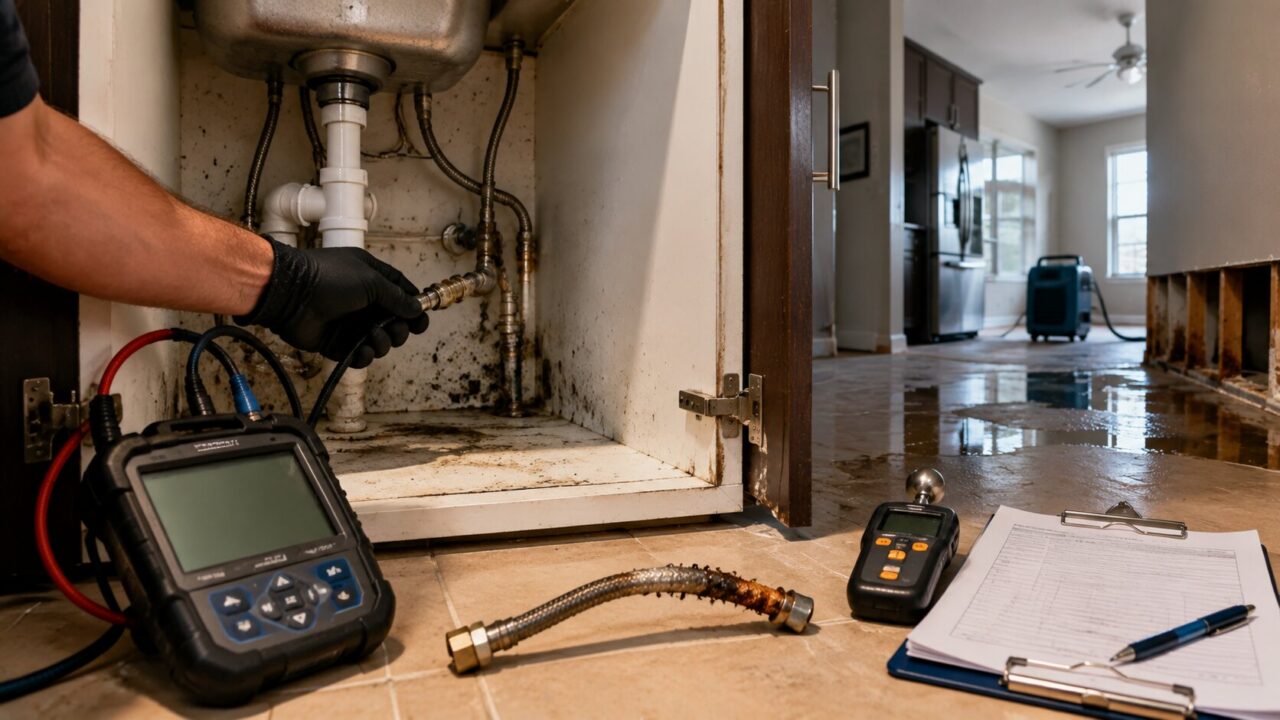
Professional plumbing testing, moisture mapping, and failure documentation help property managers record sudden supply line failures for water damage claims.
San Antonio Summer Water Pressure and Pipe Failures
If you manage a commercial property or multi-family complex in northwest San Antonio—whether it is along the busy retail stretches of Culebra Road or near the high-density residential corridors of Alamo Ranch Parkway—you are intimately familiar with the seasonal operational stresses of northwest Bexar County. During the blistering heat waves of July, lawn irrigation systems across thousands of homes activate simultaneously to comply with strict San Antonio Water System (SAWS) watering schedules. This massive, synchronized demand places an immense physical load on the local water distribution grid.
To move water uphill to higher-elevation developments near Loop 1604, SAWS municipal booster pumps must cycle continuously. This cycling creates dramatic water pressure spikes, causing line pressure to swing from a standard baseline up to high-pressure surges. These hydraulic shockwaves, or water hammer, travel through your property’s water laterals.
If your building’s Pressure Reducing Valve (PRV) is older or has drifted out of calibration, these high-pressure surges slam directly into your indoor plumbing fixtures. Under this persistent mechanical stress, degraded flexible supply lines under kitchen sinks and bathroom vanities are primed to rupture, making July the peak season for sudden, catastrophic indoor water leaks.
How July Heat Wave Surges Rupture Faucet Connectors
The primary mechanical failure point during summer water surges is the flexible braided supply line. Braided stainless steel hoses are common due to easy installation, but EPDM cores degrade under high-temperature, chlorinated water.
During July, groundwater temperatures in shallow, uninsulated municipal pipes rise significantly. When this pre-heated water enters your building’s water heaters, where it is heated further to a bactericidal temperature of 140°F, it carries a high concentration of chlorine disinfection residuals from the SAWS treatment process. Over years of continuous exposure, this chlorinated, hot water chemically attacks the internal EPDM rubber core. The chlorine breaks down the rubber’s polymer chains, causing the inner sleeve to lose its elasticity and develop microscopic stress cracks.
Simultaneously, the high humidity inside enclosed, dark sink cabinets creates condensation on the cold water metal braid. This condensation reacts with off-gassing fumes from household cleaning products stored under the sink, creating an aggressive, corrosive micro-environment. This corrosion quietly eats away at the individual stainless steel wires of the outer braid. When a SAWS water pressure spike hits, the weakened steel braid unzips, and the brittle, chlorine-degraded EPDM core balloons through the gap and bursts, releasing a continuous flow of water directly into your building’s structure.
Non-invasive Inspections for Clear Insurance Proof
When a supply line ruptures, property insurance carriers routinely inspect the damage with one primary goal: to prove the failure was a “gradual, long-term leak” caused by wear, tear, and owner neglect, which allows them to deny the claim. They will argue that the musty smell under the cabinet or the presence of limescale on the threads proves the leak was active for weeks and was ignored by your maintenance staff. Replacing a ruptured hose without documenting failure eliminates evidence needed for insurance verification.
At Five Star Plumbing, we provide the scientific, non-invasive inspection documentation required to establish a “sudden and accidental” system failure. We deploy digital manometers on-site to record real-time water pressure during municipal surge events. We conduct dynamic pressure testing to prove whether a failed PRV allowed high-pressure municipal surges to exceed safe operating limits.
We also utilize the LeakTronics Pro Complete Kit to run high-resolution acoustic testing across your walls and flooring. Our highly sensitive acoustic sensors can detect the precise sound signatures of water flowing behind drywall, while high-definition thermal imaging cameras map the moisture boundaries. This detailed, dated report provides your insurance carrier with irrefutable evidence of a sudden, high-volume rupture rather than gradual, neglected decay.
Permanent Upgrades vs. Temporary Repairs
To permanently secure your multi-family properties from repeating water damage and subsequent insurance complications, you must transition from temporary patches to engineered, high-durability plumbing upgrades.
- Low-Cost Hoses: Hiring an unlicensed handyman to install low-cost, unreinforced vinyl supply lines or cheap retail-grade braided hoses containing thin rubber cores. Under the high heat and pressure fluctuations of a San Antonio summer, these cheap components degrade rapidly, ensuring a repeat failure within twelve to twenty-four months.
- The Five Star Way: We complete code-compliant, permanent retrofits by installing commercial-grade braided lines constructed with a solid PEX inner core. PEX is a cross-linked polyethylene material that is far harder and more chemical-resistant than standard EPDM rubber, resisting expansion under high pressure and preventing the splitting that leads to sudden bursts.
Additionally, we install automated, inline water shutoff systems like Phyn Plus or Flo by Moen directly on your main water lines. These advanced water monitors utilize ultrasonic sensors to run daily, automated pressure-decay tests on your plumbing. The moment a supply line begins to fail or water flow becomes abnormal, the system automatically closes the main valve within five seconds, completely preventing catastrophic water damage.
| System Type | Leak Sensitivity | Shutoff Speed | Best Placement |
| Whole-House Inline | Exceptional | Under 5 seconds | Main water inlet |
| Point-of-Leak Puck | Localized only | Under 10 seconds | Under sink basins |
| Mechanical Turbine | Moderate flow | Variable | Main water line |
Essential Water Leak Documentation Checklist for Managers
If a fixture supply line fails in one of your San Antonio rental properties this summer, use this professional checklist to ensure your insurance claim is fully documented and protected:
- Stop the Flow and Mitigate: Immediately shut off the local isolation valve or the main water shutoff to stop active flooding. Take immediate steps to dry the area, but save the failed supply line. Never allow your maintenance staff or a contractor to throw away the ruptured hose, as insurers require the physical part to verify the cause of the leak.
- Take High-Resolution Photos: Photograph the exact point of the burst on the braided hose, the corroded metal threads, and any cleaning chemical bottles stored adjacent to the line. Also, document the standing water, saturated drywall, and ruined cabinet bases before any restoration fans or dehumidifiers are set up.
- Request a Plumber’s Inspection Report: Have a licensed plumber conduct a static and dynamic pressure test using a digital manometer. The written report must state the home’s water pressure, verify whether the PRV is operating correctly, and confirm that the supply line suffered a sudden, high-pressure rupture.
- Secure Professional Moisture Mapping: Work with a certified water mitigation specialist who can provide a detailed moisture map using specialized meters. This map proves the exact boundary of the affected drywall, flooring, and structural framing, preventing the insurance adjuster from underestimating the required repair scope.
- Log All Communications: Maintain a detailed, written log of all phone calls, emails, and site visits with your tenants, property staff, plumbers, and the insurance adjuster. Under the Texas RCLA notice-and-repair guidelines, having clear documentation of your prompt response is critical to proving your property complied with its legal obligation to mitigate the damage.
Protect Your San Antonio Property Portfolio Today
High municipal water pressure combined with aged fixtures increases the risk of July supply line ruptures. Delaying inspection or replacement of degraded hoses can result in 10–20 gallons per minute flooding and structural damage. At Five Star Plumbing, we provide the licensed expertise, advanced inspection tools, and comprehensive system documentation needed to keep your properties safe, compliant, and protected from water damage. Julian Campos and our professional team specialize in commercial-grade PVD fixture upgrades, automated leak detection installations, and comprehensive pressure audits across northwest Bexar County. Reach out to Five Star Plumbing at (210) 673-0797 and at 2780 FM471, Castroville, TX 78009 today to schedule your system inspection and secure your property before the summer peak wave arrives!
Frequently Asked Questions
Does insurance cover a burst sink supply line?
Yes, most commercial and residential property policies cover sudden and accidental water damage caused by a ruptured fixture supply line, provided the failure was not due to known, unresolved maintenance neglect.
Will a failed pressure regulator void my water damage claim?
No, a failed Pressure Reducing Valve is considered a sudden mechanical failure, meaning any subsequent water damage is typically covered, but you must replace the failed regulator immediately to prevent future claims from being denied.
Can I throw away the failed supply line after the plumber replaces it?
No, insurance adjusters require physical evidence of the failed component to verify the cause of the water loss, and discarding the ruptured braided line can result in your claim being delayed or denied.
Do property managers need building permits for simple supply line repairs?
No, standard “like-for-like” replacements of flexible supply lines and faucet connections do not require building permits under San Antonio development codes, but full structural dry-outs and drywall reconstruction may require localized inspections.