
Well Water Fixtures in Castroville
Rural well owners in Castroville face high iron and extreme mineral levels that ruin standard plumbing fixture finishes. Utilizing physical vapor deposition fixtures prevents staining, pitting, and corrosion. We test well water and install custom softeners to prevent stained, pitted faucets and extend fixture life on rural Medina County homes.
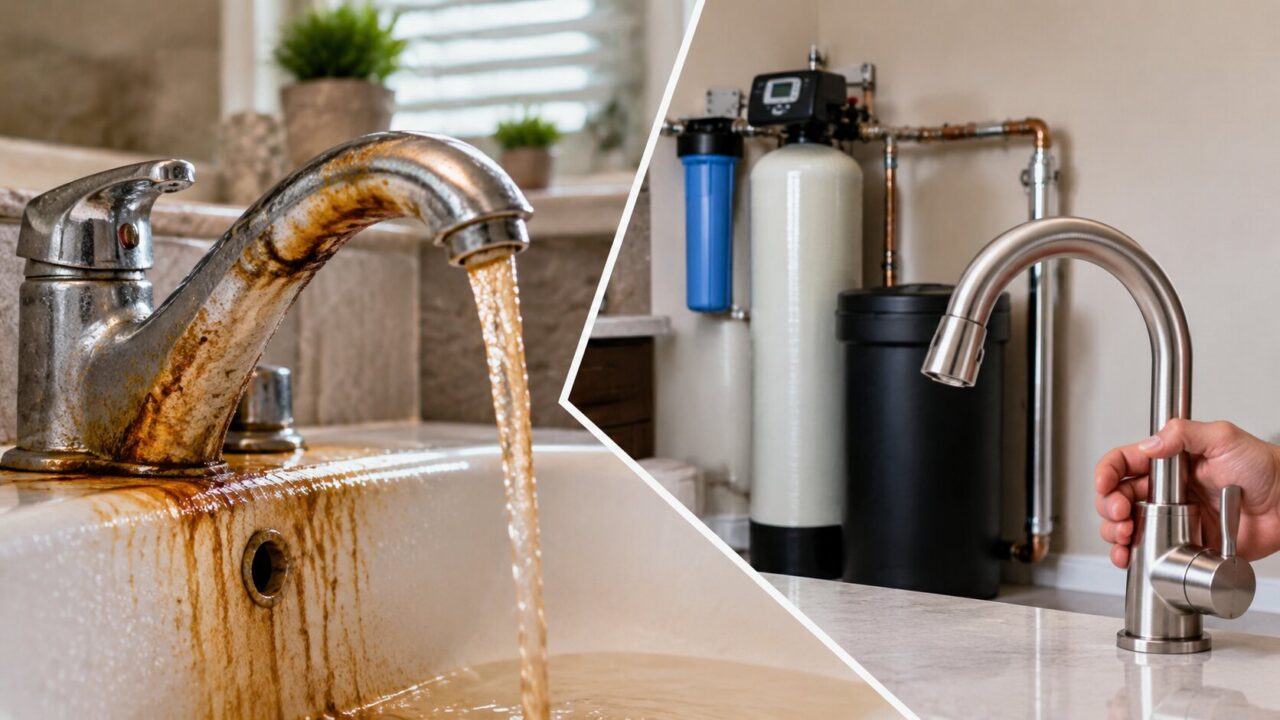
Iron-heavy well water can cause orange stains, mineral buildup, and faucet corrosion. Proper filtration and durable fixtures help protect rural Medina County homes.
Medina County Aquifers and the Well Water Threat
If you drive down FM471 past the rolling farmland or head west on U.S. Highway 90 toward the Medina River, you are crossing a vast network of private water wells. Unlike homes inside the Castroville city limits that receive treated municipal water, rural properties in Medina County rely on private wells tapping into the deep limestone of the Edwards or Trinity Aquifers.
Most rural wells around Castroville are pulling untreated mineral-heavy water straight into residential plumbing systems. Well water in this part of Texas is exceptionally hard, frequently exceeding 300 parts per million of dissolved calcium and magnesium.
Worse still, rural Medina County wells often carry high concentrations of dissolved iron. This untreated chemical profile quickly destroys standard, builder-grade retail faucets and showerheads, resulting in premature oxidation and hardware failure.
Technical Analysis of Mineral and Iron Oxidation
The rapid deterioration of rural plumbing fixtures stems from two distinct chemical processes: limescale precipitation and iron oxidation. Well water contains dissolved ferrous iron, which is completely soluble and invisible while underground. However, the moment this water exits your faucet aerator, it mixes with atmospheric oxygen.
This exposure triggers a rapid oxidation process, transforming the clear ferrous iron into insoluble ferric iron. The ferric iron precipitates out of solution as a fine, rust-colored particulate that stains porcelain sink basins and permanently discolors classic chrome and brushed nickel finishes.
Simultaneously, the high concentration of calcium and magnesium bicarbonate in the water precipitates as hard limescale whenever water temperatures rise or water evaporates on the fixture surface.
Here’s what we actually see inside failed cartridges:
- Abrasive Scale Growth: Crystalline calcium carbonate builds up on the internal moving parts of your faucet cartridges.
- Particulate Trapping: The rough limescale acts as a microscopic sponge, trapping oxidized iron particles and binding them to the metal surfaces.
- Cartridge Scoring: This rough, mineral-and-iron matrix creates severe friction inside the valve, tearing rubber O-rings, scratching ceramic discs, and seizing the handle mechanism.
Ultimately, the excessive back-pressure from clogged aerator screens forces water backward past the worn internal seals, leading to silent, costly water damage inside your under-sink cabinetry.
Advanced Water Testing and Inspection Precision
Most plumbers just swap out a faucet. We measure water hardness, iron levels, and pressure to fix the root cause and stop repeat failures.
When we arrive at a rural Castroville property, our first step is drawing a sterile water sample directly from the well pressure tank to conduct a comprehensive chemical profile. We test for total dissolved solids, calcium hardness grains, pH, and both dissolved and particulate iron levels.
Next, we connect a digital manometer to your pressure tank manifold to conduct a dynamic pressure audit. Well pump pressure switches can drift out of calibration, allowing high-pressure surges to stress your household plumbing. If your system is running above 80 psi, it will blow out fixture gaskets.
Finally, we utilize the LeakTronics Pro Complete Kit to run non-invasive acoustic testing. Shifting clay soils along FM471 can stress underground well lines, and our acoustic sensors can isolate sub-surface leaks before we recommend any filtration or fixture upgrades.
Choosing Physical Vapor Deposition over Standard Finishes
Standard retail faucets rely on electroplated finishes, where a thin layer of chrome or nickel is chemically bonded over a cheap zinc-alloy body. In a rural well-water environment, the abrasive limescale and acidic iron deposits quickly eat through this thin plating, causing it to flake, pit, and expose the reactive raw metal underneath.
For rural well owners, we exclusively recommend upgrading to fixtures featuring a Physical Vapor Deposition (PVD) finish.
The reason we push PVD on rural Medina County wells is simple: standard chrome starts pitting fast once iron and calcium deposits bake onto the surface.
PVD finishes are highly resistant to scratching, flaking, and chemical attack. Limescale and iron cannot easily bind to the slick, non-porous PVD surface, allowing you to easily wipe away mineral spots with a soft cloth and protecting the fixture’s aesthetic value for decades.
| Fixture Feature | Standard Electroplated Finish | Premium PVD Finish |
| Surface Hardness | Moderate (Prone to scratching) | Exceptional (Industrial-grade) |
| Scaling Adhesion | High (Mineral scale bonds easily) | Low (Slick, easy-to-clean surface) |
| Corrosion Resistance | Poor (Pits and flakes in hard water) | Outstanding (Immune to oxidation) |
| Internal Cartridge | Plastic / Compression rubber | Solid brass / Ceramic disc |
Preventive Filtration Strategies for Rural Properties
PVD helps, but to stop mineral damage for good, we install a staged water treatment system based on your well water test.
- Sizing the Softener: Standard municipal softeners are too small for rural demands. We custom-size whole-house water softeners based on your water’s specific grains of hardness, using demand-initiated regeneration heads to conserve water.
- **Dedicated Iron Filtration:**On wells with high iron (often 2.5+ ppm), a standard softener clogs quickly, so we install oxidizing iron filters upstream.
- Dielectric Transitions: Well-head piping often mixes galvanized steel and brass fittings. We install certified dielectric unions to prevent the rapid galvanic corrosion that causes well-line joint shears.
Protect Your Rural Castroville Home Today
If your faucets are already showing orange staining or your handles feel gritty when turning, your well chemistry is already attacking the cartridge assembly. Don’t let untreated well water destroy your plumbing system. At Five Star Plumbing, we provide the licensed expertise, well-water experience, and advanced inspection tools needed to complete code-compliant, permanent upgrades. Julian Campos and our certified team specialize in custom water softeners, PVD fixture retrofits, and iron filtration systems across Medina County. Reach out to Five Star Plumbing at (210) 673-0797 and at 2780 FM471, Castroville, TX 78009 today to schedule your early summer outdoor plumbing inspection and secure your property before the summer heat wave peaks!
Frequently Asked Questions
Does iron in well water ruin faucet finishes?
Yes, dissolved ferrous iron oxidizes into insoluble ferric iron upon contact with the air, leaving stubborn red-orange rust stains that chemically bond to and corrode standard electroplated finishes.
Is PVD more durable than chrome for well water?
Yes, Physical Vapor Deposition (PVD) finishes are molecularly bonded in a high-vacuum chamber, creating an incredibly dense, scratch-resistant surface that prevents hard water minerals and iron from pitting the metal.
Will a standard water softener remove all well-water iron?
No, standard water softeners can only remove small amounts of dissolved iron. If your iron levels are high, the mineral will quickly foul the resin bed, necessitating a dedicated oxidizing iron filter to prevent system failure.
Do I need a permit to install a well filtration system?
No, simple residential water treatment and filtration installations are generally exempt from permit requirements under Chapter 10 of the building code, provided there is no modification to your main sewage or drainage lines.